
There are two quiet assumptions most managers carry into their 1:1s.
One: Either it is their meeting, their agenda to drive.
Second: Or the opposite, that the direct report is coming prepared, so there is nothing much to do except show up and respond.
Both feel reasonable in the moment. Both assumptions quietly hand over the most important part of the conversation to each other, before it has even started.
It is worth questioning that, specially the first assumption.
If the manager walks in treating it as theirs to run, and the direct report shows up to answer questions instead of bringing their own. That is a different conversation. A worse one.
Rather, a different way to think about the flow of 1:1 is simple.
Think of this flow as a reference flow, not a checklist.
We will shortly talk about what should be covered in each of those boxes (the actual content of the 1:1), but first lets talk about ownership of the 1:1.
Who owns the agenda in a 1:1?
Generally speaking, I recommend that the direct report’s topics come first. The manager’s come after, unless something is genuinely time-critical and cannot wait from the manager, it can then go first of-course. Remember we are not setting rules here, but just generally good practices.
Because when a manager front-loads their priorities in a 1:1, the frame is set before the direct has had a chance to open up. By the time the conversation gets to how they are doing, it has already been told what it is about.
What tends to happen when you do the opposite (i.e when a direct knows that the first part of the call belongs to them) is that things surface that would never come up the other way around.
What are the topics to actually cover?
Let us assume ideal scenario that the above flow persists. The direct report leads the 1:1.
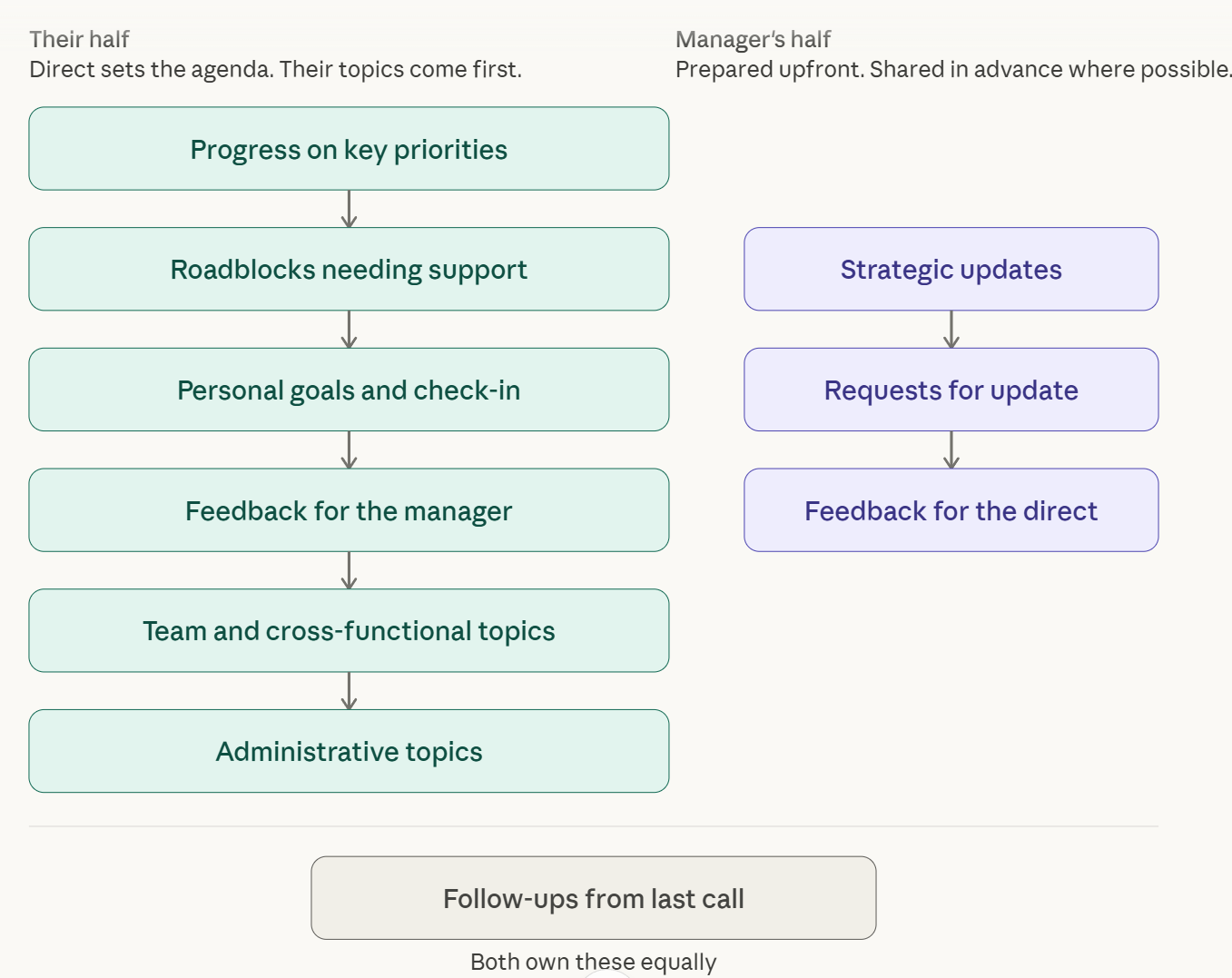
The direct report starts the 1:1, starting with progress on key priorities. This is not a status check, but to understand where the direct report is genuinely moving or stuck. Then roadblocks that need support, the things the direct cannot resolve without the manager in the room.
Then go into cross-functional relationships and team topics, because no matter how smart the direct report might be, everyone is struggling with their share of cross functional collaboration issues and relationships. You, as manager, need to be able to coach and mentor
Then the personal dimensions. Goals, aspirations, how the direct is actually doing as a person. This is the part many managers treat as small talk. It is not. It is often where what is actually going on becomes visible. And if the moment is right, it is also where a conversation about their growth as a manager or leader can happen naturally. Not a formal review but just a question about how they are thinking about their own style, where they feel uncertain, what kind of leader they want to become.
After that, feedback for the manager named on the agenda, not tucked in as an afterthought. When it appears informally, directs tend to give something safe. Putting it on the agenda signals the manager actually wants to know.
And then anything administrative that needs covering. (Approvals, FYIs and more)
Then the manager can start sharing their own list of items around important updates, strategic context, requests for updates on specific goals and also feedback to the direct report.
When both sides have a lot to cover
Sometimes both people come in with full lists. This is where something Bill Campbell practiced is worth borrowing (he coached Steve Jobs, Eric Schmidt, Larry Page and many others across Silicon Valley)
What is striking about Campbell’s approach is not the scale of who he worked with but how seriously he took the act of listening itself. He believed the quality of a conversation depends on who gets to frame it first, and he was careful never to let that default to himself.
Before his 1:1s, both he and the other person would independently write down the topics they wanted to discuss, then share their lists at the same time. Not one after the other. Together. The agenda was built from the overlap and the gaps, not from whoever spoke first. When both sides have a lot on their minds, that small act of simultaneity changes the whole register of the conversation.
Showing up prepared
If the direct sends context before the call, the deal is simple… read it. They prepared, so the manager prepares. It makes the conversation sharper and shorter. Nobody is catching the other up. Both are actually talking.
Same goes the other way. If the manager needs to bring something, sharing context upfront matters. Asking a direct to react in real time to something they have never seen is not a conversation. It is a slower ambush.
Here is how the full agenda breaks down. Not every theme needs to appear in every call. This is a reference point, not a script.
The honest version
A perfect 1:1 every week is not realistic. Sometimes the manager front-loads. Sometimes there is no time left for their own topics, which is usually fine. Sometimes the conversation goes somewhere the agenda never anticipated, and that turns out to be exactly right.
A 1:1 is not about completing a list.
It is about the direct report leaving the call feeling like their work was seen, their blockers were taken seriously, and their growth actually matters.
That is manager’s whole job.