
Here’s the thing: while everyone is busy arguing about whether OpenAI or Anthropic hits 30 billion dollars in revenue first, a French upstart quietly 20x’d its ARR in about a year and now expects to cross a billion in 2026.
That company is Mistral AI and if you care about positioning as a product lever, it is one of the sharpest live case studies you can study right now.
Why Mistral deserves your attention
On raw numbers, Mistral AI looks small next to the US giants.
OpenAI is reportedly sitting in the mid‑20 billions of annualized revenue. Anthropic is said to have crossed a 30‑billion‑dollar run rate and, in some accounts, is now ahead of OpenAI on enterprise revenue. xAI and its Grok assistant show up at under five percent of OpenAI’s revenue on comparative charts—which still puts them under the billion‑plus mark, but with a far bigger valuation story attached.
Now drop Mistral onto that axis. It is at roughly 400 million dollars in ARR as of early 2026, up from about 20 million a year earlier. Management has been openly guiding toward roughly 1.1 to 1.2 billion dollars in revenue for full‑year 2026. On the private markets, it is valued somewhere around 11.7 to 14 billion dollars, with European industrial giants on the cap table.
So no, Mistral is not “beating” OpenAI or Anthropic on size. That is the wrong scoreboard.
The right question is:
How did a three‑year‑old European lab find a wedge so sharp that it could 20x revenue in a year, in a space dominated by US players?
Mistral AI is playing on a different positioning
Mistral’s bet is simple to say and hard to pull off: there is a large and growing group of customers who want powerful generative AI but do not want to be fully dependent on US platforms and closed APIs.
Their positioning rests on three pillars.
First, sovereignty. Mistral is a European lab, headquartered in Paris, that leans directly into the “AI independence” narrative in Europe. Governments and enterprises that are uncomfortable building their core workflows entirely on US hyperscaler stacks see this as a strategic diversification move, not just a technical choice.
Second, open weights. Mistral became famous by releasing strong open‑weight models, think Mistral 7B, Mixtral and successors that developers can download, fine‑tune and run themselves. This is a very different stance from “you may only access our intelligence via a black‑box API.” It gives banks, insurers and public‑sector teams a sense of control they do not get from pure SaaS.
Third, efficiency. Through mixture‑of‑experts architectures and careful optimization, Mistral aims to deliver GPT‑3.5‑class (and increasingly better) capability at significantly lower compute and unit cost than many rivals. For buyers, that shows up as fewer GPUs, lower cloud bills and a more manageable TCO once workloads scale.
If you translate that into buyer language, the pitch sounds like: “Get frontier‑class AI, keep control of your stack, and keep your regulators less nervous.” That is a very different story from “we are Europe’s ChatGPT.”
OpenAI is trying to be the everything platform. Anthropic is trying to be the safest enterprise default. xAI is playing the culture‑plus‑distribution game inside the Musk ecosystem.
Mistral is aiming to be the sovereign, efficient enterprise layer for customers that want power without full dependency on US labs.
The growth curve that proves the story
Chart 1: Mistral’s ARR slope
The important bit here is the bend in the line, not the absolute numbers. That bend lines up with two macro shifts:
Europe leaning harder into the AI‑sovereignty narrative.
A wave of enterprise and government deals where Mistral’s story sovereign, open, efficient matches the procurement anxiety.
Chart 2: How Mistral compares with ChatGPT, Anthropic and Grok
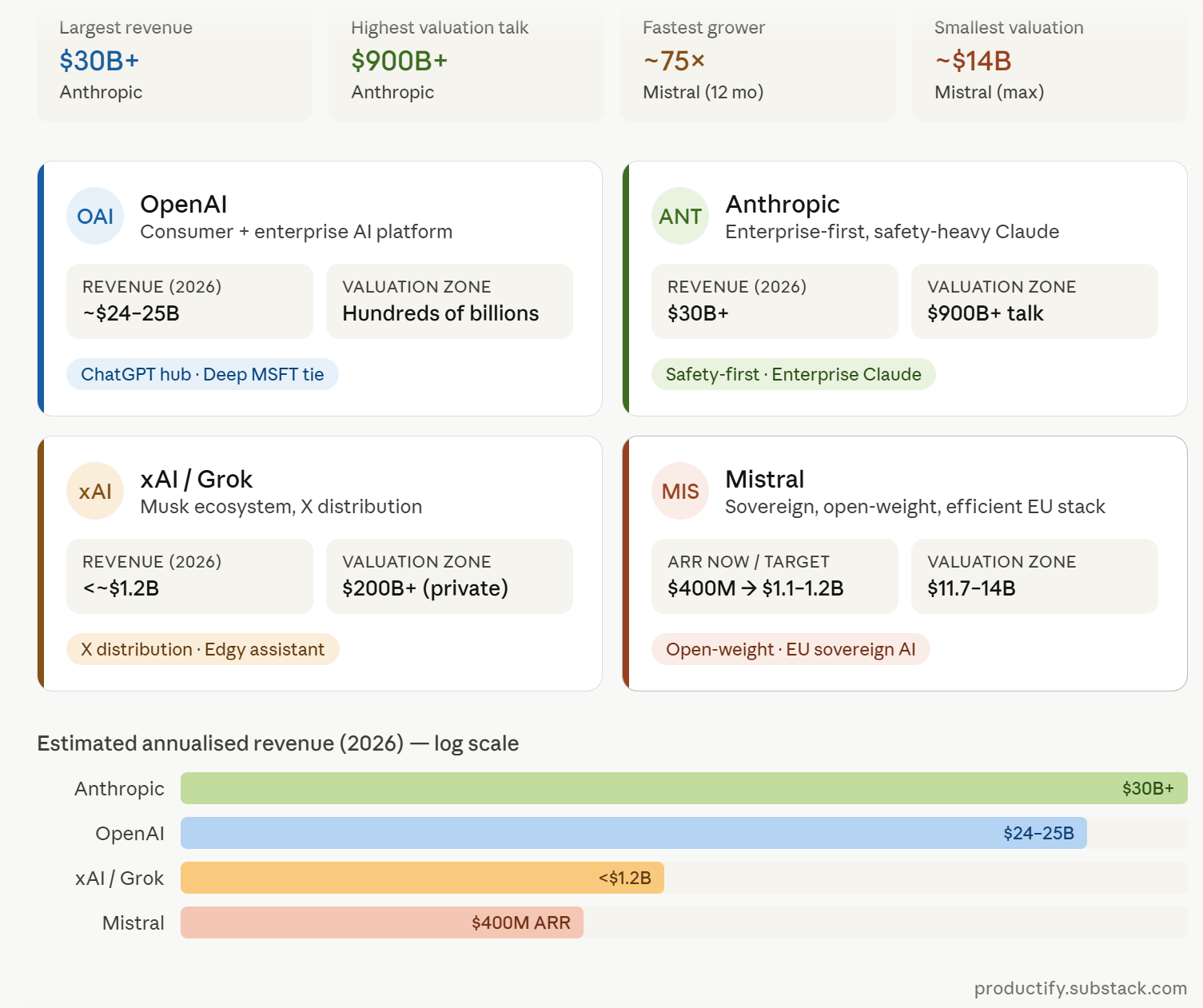
Mistral, on an “AI overall” scoreboard it looks mid‑table, but on the “we care about control and jurisdiction” axis it suddenly looks like one of the most credible options in the world.
Who is actually buying Mistral AI products and solutions?
Large European financial institutions (think big banks and insurers) are using Mistral models and assistants for internal productivity tools, document understanding and decision support.
A global logistics player has rolled out an AI assistant based on Mistral to more than 100,000 employees across 160+ countries.
Mistral models are embedded into products from SAP, Cisco, Snowflake and others, putting them inside existing enterprise workflows without having to own every UI surface end‑to‑end.
On the revenue side, reporting suggests that a majority of Mistral’s revenue still comes from Europe, with the rest split between the US and Asia. Also a pattern emerges: regulated, multinational, infrastructure‑heavy customers who care deeply about jurisdiction, data handling and vendor concentration risk.
That is not the same buyer as the casual ChatGPT user. It is the same buyer as your typical bank, payments company, or government department.
What is Mistral actually selling them?
From a product lens, Mistral is not “a chatbot company.” It is a ladder.
At the bottom of the ladder are open models: strong open‑weight models anyone can download, experiment with and embed. That creates gravity with engineers and startups.
Above that sit hosted APIs: the same models, but delivered as a service, with usage‑based pricing for teams that do not want to manage infra.
For larger customers, there are private and on‑premise deployments: dedicated clusters, regional hosting, or on‑site options that satisfy strict regulatory and security constraints.
At the top you have Le Chat and other tools: direct interfaces for knowledge workers and developers that simultaneously act as products and discovery surfaces for the underlying stack.
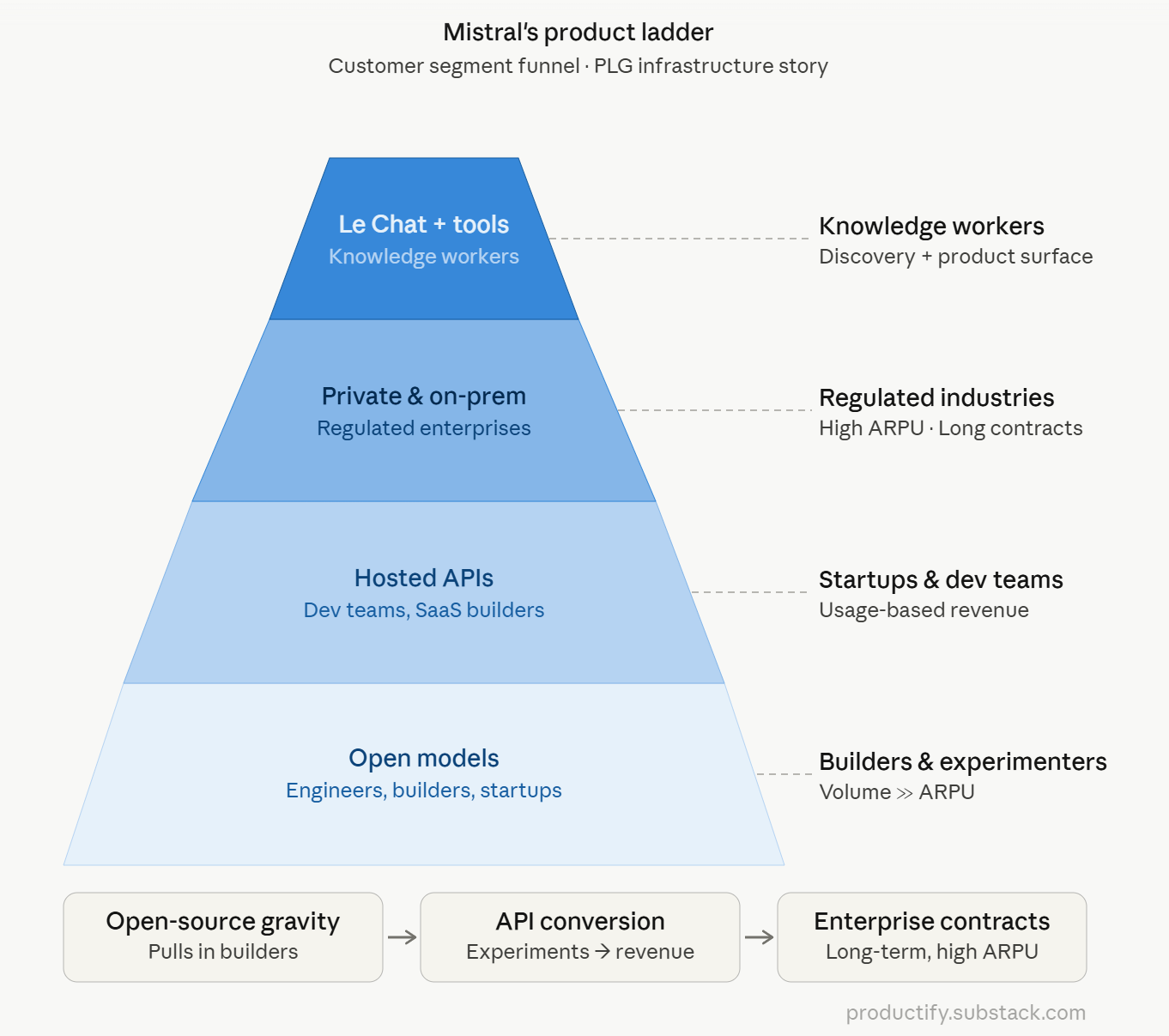
If you sketch that as a funnel, you get a classic PLG‑ish infrastructure story:
Open‑source gravity pulls in builders.
APIs convert experiments into usage and revenue.
Enterprise deployments and partnerships turn usage into high‑ARPU, long‑term contracts.
The counterintuitive bit: being smaller can be safer
From a national‑security or regulator perspective, depending entirely on one or two US labs for your cognitive stack is a risk, not just a convenience. That is the backdrop to a lot of European talk about “AI strategic autonomy.”
Mistral’s smaller size, European base and open‑weight strategy turn that risk into an opportunity. When the CEO says they expect about one billion euros in revenue in 2026, he is also clear that they will still be far behind OpenAI and Anthropic on absolute revenue. That honesty is part of the positioning. They are not claiming to be the new monopoly. They are offering to be the second or third rail.
For a product builder, this is a clean example of turning constraints into strategy. Mistral cannot outspend OpenAI on model training, so it optimizes for efficiency and sovereignty and builds a business around those constraints instead of apologizing for them.
How the positioning shows up in the numbers
1. Revenue slope, not just revenue level
The jump from roughly 20 million ARR to over 400 million in about a year is the headline. That kind of acceleration usually means you have found a segment with urgent, underserved demand and a story that resonates with that segment.
2. Valuation in context
On a roughly 400‑million‑dollar ARR base and a clear path to a billion in revenue, a low‑teens‑billion valuation looks rich but grounded. Put that next to xAI, with marks north of 200 billion on revenue that is still a fraction of OpenAI’s, and you get a sense that one is priced on narrative alone and the other on a specific enterprise wedge.
3. Region and customer mix
A revenue base that is mostly European, anchored in banks, insurers, industrials and infrastructure operators, looks exactly like what you would expect from a “sovereign enterprise infrastructure” play. When your region chart and your logo sheet tell the same story, you know your positioning has made it out of the deck and into reality.
Key Takeaways
Pick a sharp wedge, not a vague ambition.
Mistral did not aim to “beat OpenAI across the board.” It aimed to be the best choice for enterprises and governments that care about control, sovereignty and cost. The revenue slope suggests that was a smart constraint.Make the positioning visible in the product and contracts.
Open weights, on‑prem deployments, EU data centers, and a partner‑heavy go‑to‑market are not random decisions. They are how “sovereign and flexible” becomes tangible. If your positioning only exists in your Notion doc, it does not exist.Measure slope and fit, not just absolute size.
On absolute revenue, Mistral will lose to OpenAI and Anthropic for years. On the “who is best positioned to serve sovereignty‑focused enterprises” dimension, it suddenly looks like a category leader. Design your metrics to reveal whether your strategy is working in your chosen wedge.Leverage constraints as features.
Limited capital and compute pushed Mistral into efficiency and open models. European politics pushed it into sovereignty. Those constraints became its headline features. Many product teams have similar “constraints” waiting to be reframed.
List of Sources:
Mistral Revenue, ARR Growth, and Data-Center Build-Out
https://www.trendingtopics.eu/mistral-increases-arr-to-400-million-builds-its-own-ai-data-centers/
https://sacra.com/c/mistral/
https://economy.com.pk/mistrals-revenues-soar-over-400m-as-europe-accelerates-push-for-ai-independence/
https://www.reddit.com/r/BuyFromEU/comments/1rjlpaw/mistrals_annualized_revenue_has_surged_from_20/
https://www.linkedin.com/posts/seb-johnson_just-in-mistral-ai-has-20xed-revenue-in-activity-7427399490703167488-rm0z
https://www.ft.com/content/664249e7-e8d5-4425-b397-ad3ed590b305
Mistral Guidance, Valuation, and European Autonomy Angle
https://www.lemonde.fr/en/economy/article/2026/01/22/french-ai-firm-mistral-predicts-revenue-of-1-billion-in-2026_6749706_19.html
https://cloudsummit.eu/blog/mistral-ai-14-billion-valuation-europe-turning-point
https://ioplus.nl/en/posts/why-mistrals-830m-raise-is-a-win-for-european-autonomy
https://www.gend.co/blog/mistral-ai-e1b-revenue-2026
https://economictimes.com/tech/artificial-intelligence/french-ai-firm-mistral-expects-1-2-billion-in-2026-revenue/articleshow/107912877.cms
OpenAI and Anthropic Revenue Comparisons & “Duopoly” Charts
https://www.trendingtopics.eu/anthropic-overtakes-openai-in-revenue-hitting-30-billion-run-rate/
https://www.voronoiapp.com/technology/Revenue-Chart-OpenAI-Anthropic-Building-Duopoly-at-Historic-Speed-7943
https://www.linkedin.com/posts/moohammad-akif_openai-vs-anthropic-revenue-the-30b-crossover-activity-7447966989119209472-mT3w
https://www.reuters.com/technology/artificial-intelligence/openai-versus-anthropic-what-revenue-race-means-their-ipos-2026-04-08
https://searchlab.nl/en/statistics/openai-statistics-2026
https://www.forbes.com/sites/josipamajic/2026/03/25/openai-and-anthropic-count-revenue-differently-and-investors-are-looking-into-it
https://stormy.ai/blog/anthropic-vs-openai-2026-enterprise-growth
xAI / Grok Revenue and Valuation
https://sacra.com/research/xai-vs-openai-vs-anthropic/
https://www.voronoiapp.com/technology/Revenue-Chart-OpenAI-Anthropic-Building-Duopoly-at-Historic-Speed-7943
https://www.premieralts.com/companies/xai/valuation
https://www.linkedin.com/posts/seb-johnson_just-in-mistral-ai-has-20xed-revenue-in-activity-7427399490703167488-rm0z
Mistral Models, Open-Weight Strategy, Customers & Solutions
https://mistral.ai
https://www.ibm.com/think/topics/mistral-ai
https://mistral.ai/solutions
https://mistral.ai/customers
https://ahmadullin.com/mistral-ai-product-scaling/
https://tldl.io/blog/ai-mistral-sovereign-ai-europe