
There’s a word that quietly shapes how most of us think about professional growth: average. In statistics, the mean is the center of the bell curve. The most common, the most expected, the most... replaceable.
And right now, AI is becoming very, very good at the mean.
When we say “don’t be mean with AI,” we’re not talking about manners. We’re talking about the mathematical kind of mean. The middle of the bell curve, the safe average, the skills that every PM is expected to have. Because here’s the uncomfortable truth: if your competitive edge lives in the middle of that curve, you’re competing with a system that has read every product document, framework, and case study ever published. You will not win that race. And more importantly, you don’t need to.
The real opportunity is in the tails.
The Bell Curve Nobody Warned You About
Picture a classic bell curve. The tall, wide middle represents the skills that define a “standard” PM: writing user stories, summarizing research, building roadmaps, running prioritization frameworks, creating decks. These are table stakes. They’re also exactly what AI tools now do in seconds.
This isn’t a criticism of those skills. They matter, and you still need to understand them. But competing on them is like training to be the world’s fastest calculator. The middle of the curve is crowded, and AI just moved in permanently.
Now look at the slopes on either side. These represent the skills that are rare, contextual, deeply human, or so specialized that no general-purpose model can reliably replicate them. This is where your career should live.
There are two tails worth understanding: the left tail of deep niche expertise, and the right tail of human and relational intelligence. The best PMs don’t just lean into one. They find their unique combination of both.
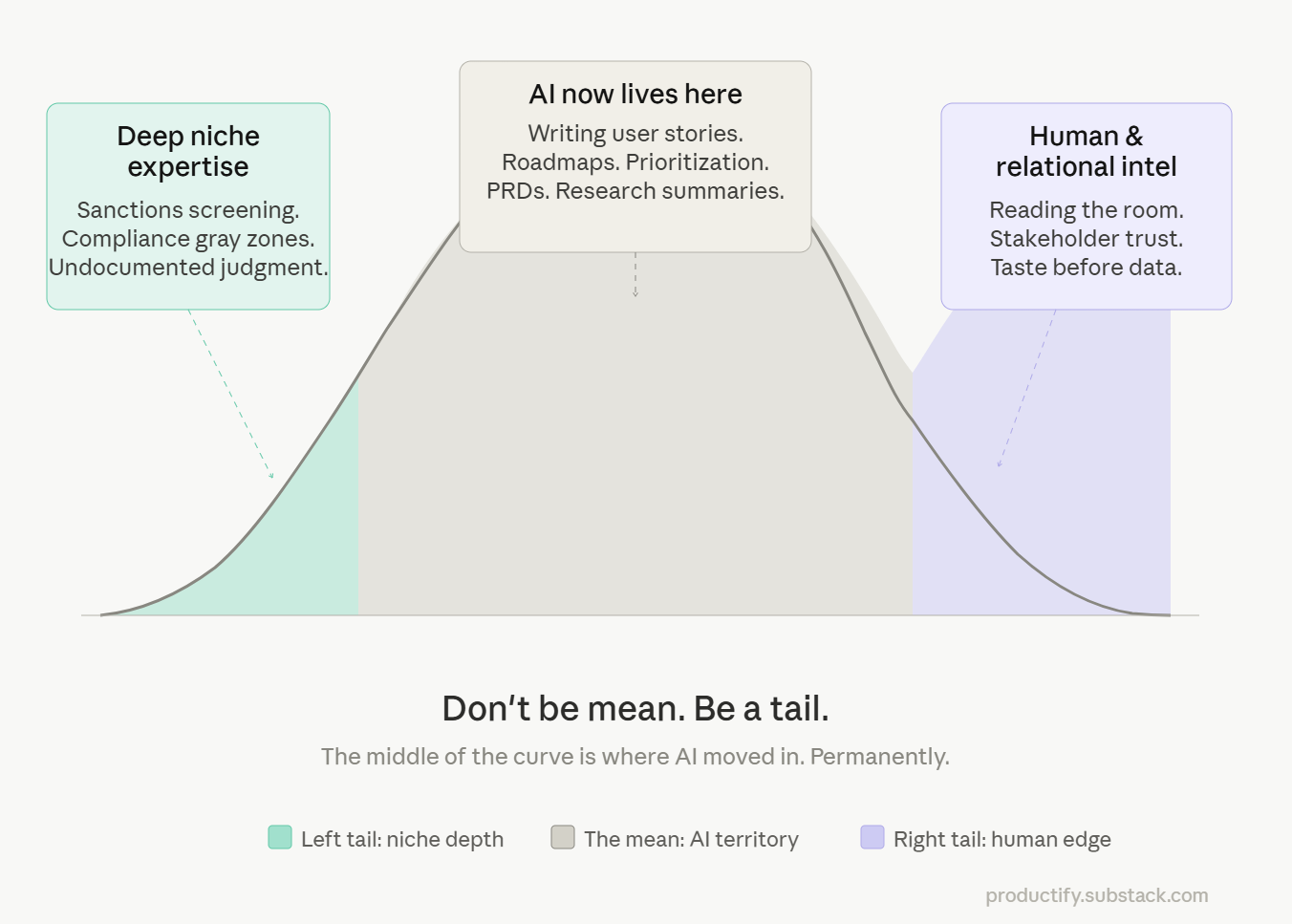
The Left Tail: Go Narrower Than AI Can Follow
AI is broad by design. It knows a little about everything, and a lot about commonly documented things. What it struggles with is the specific, contextual, and undocumented knowledge that lives in your industry’s back rooms and in the heads of people who’ve been doing it for decades.
A PM who deeply understands how sanctions screening works in cross-border SEPA payments, not just the Wikipedia version but the edge cases, the vendor quirks, the compliance gray zones, is not easily replaced. A PM who knows which KPIs a specific type of bank actually trusts versus which ones just sound good in a pitch carries irreplaceable knowledge.
The move here is to go narrower, not broader. Pick your domain and go deep enough that AI becomes your research assistant, not your replacement. The goal isn’t to know more facts. It’s to have the judgment that comes from being inside a problem for years.
The Right Tail: The Room AI Can’t Read
There’s a skill that every experienced PM quietly develops and almost no one talks about openly: reading a room. Not the surface-level kind. The deeper kind, where you notice that the CTO nodded along to your entire roadmap presentation but hasn’t committed to a single engineering resource. Or where you sense that the founder’s “let’s explore this” actually means “I already decided.”
This is relational intelligence, and it sits firmly in the right tail of the bell curve.
AI can process sentiment in a transcript. It cannot feel the tension in a room before the meeting even starts. It cannot build the kind of trust with a skeptical engineering team that comes from showing up consistently, admitting mistakes early, and knowing when not to push. It cannot sit with ambiguity in a way that makes everyone around it feel safe. That is a peculiarly human skill, and it matters enormously.
For PMs, this tail also includes taste: the ability to know what “good” feels like for your users before the data confirms it. It includes stakeholder navigation across politics, personalities, and competing incentives. These skills compound quietly over years and they’re genuinely hard to fake, for humans or machines.
Your Personal Audit
Here’s a simple exercise worth doing this week. Write down your top five professional strengths, the things you’d put on a resume or mention in a performance review. Then ask one honest question about each: Is this something AI can now do adequately?
If the answer is yes for most of them, that’s not a crisis. It’s a signal. It means you have room to shift your investment. Spend less energy perfecting the PRD format and more energy developing the stakeholder instinct. Go deeper into your industry niche instead of wider into generic PM frameworks. Build the skills that live in the tails, because that’s where AI isn’t, and where, for the foreseeable future, it won’t be.
The bell curve isn’t your enemy. It’s a map. And now you know where not to stand.
Don’t be mean. Be a tail.